
This year our Company, LocalTrifecta Internet Marketing took 5 team members to MozCon - known as the LocalTrifecta 5.
This is going to be some sort of special MozCon review post. Four of us are contributing, and this is a lengthy post, but there’s great stuff here. And at the very end we’ve included links to other MozCon 2014 reviews.
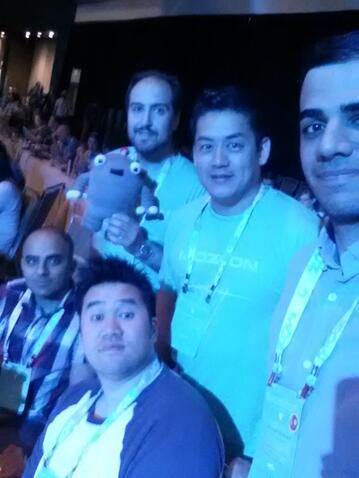
Drew, Sam, Payman and Lincoln at MozCon 2014 in really bad lighting.
Sam's 5 MozCon Takeaways
I’ll keep this concise.
My takeaways aren’t necessarily profound, or founded in the ethers of marketing brilliance. I am, afterall, a normal guy who loves marketing, people, and eating. Not to be confused with marketing eating people or eating marketing people.
1. Be Innovative
Lindsay Wassell talked about thinking beyond the obvious.
*I agree - What makes you special? What makes your client special? Are you making effort to do great things that others aren’t doing?
2. +1 For Team Culture
Richard Millington talked about building addicting communities.
*As an agency head, my most important community is my team. What one ritual/tradition can we add to our team culture by the end of 2014?
3. Happy Client, Happy Life
Local was Mike Ramsey’s, theme and how ironic that Moz doesn’t have its own Local stuff straight, but if anyone shared simple actions, it was Mike.
*If you aren’t using call tracking - CallRail is great! And getting reviews from clients influences ranking - so get on it. Take a look at GetFiveStars.com.
4. YouTube IS Golden
Gandolf Jr. aka Phil Nottingham (One year I just want to see Phil’s hair turn white and have him walk on stage with a staff) don’t make mistakes so many others have made and keep from having your videos become part of the YouTube wasteland.
*Just go through his golden slidedeck yourself.
5. Passion
Love what you do, and it will love you back. Do you think Rand Fishkin or Will Reynolds love what they do? You betcha. This isn’t from any one particular speaker, but was the culmination of MozCon experience. It’s easy to be overwhelmed by so much information. If you’re truly passionate you won’t just write blog posts on your top X takeaways from whatever. You’ll write it and DO it. There were many inspiring non-speakers I met. And hanging and bunking with the LocalTrifecta 5 was -fun.
Take Action and Be a Better Marketer
Just take 5 simple things and put them into ACTION! Maybe it was an idea that came to mind as a result of listening to a speaker or hearing the drunken rant of a mid-west agency account executive - or maybe it was something that actually came from a speaker ;) - the point is, don’t over complicate things. Make your MozCon experience worth it, and become a better marketer.
And, if you didn’t attend MozCon - good for you. You saved yourself hundreds of dollars, many hours, and you don’t even have to read further … Muhahahah, as I pass the baton …
Drew’s 5 MozCon Takeaways
After an incredibly rewarding 3 days in Seattle for MozCon, my colleagues and I came away with a ton of actionable ideas-- and 1 or 2 delicious drinks-- in the process.

Drew with MozBot at MozCon 2014.
Choosing only 5 key takeaways from such a smorgasbord of digital marketing goodness is tough, but here goes:
1. Intelligent Testing (Minimum Detectable Effect)
Optimizely’s Kyle Rush regaled us with a complete look at how to run effective, correct A/B testing for any client’s online campaign.
While the full story would easily take up several informative books, an important part of the talk was determining your test’s MDE (Minimum Desirable Effect).
Successful tests are based around this principle, where you decide on a % improvement you’d like to test for, from the current, baseline conversion rate your landing page, webpage, or other online element is experiencing.
If you don’t know what you’re trying to test for, or don’t have any goals relating to how much you’re wanting to improve an online experiment, you may get incorrect, costly results.
While it’s another step before conducting a test, the MDE of your experiment is vitally important.
There’s a great article outlining this important jumping off point-- along with a whole slough of other important figures-- that you’ll need to run a meaningful test, right here: Bit.ly/SWR3YC
2. Customer Triangulating in Google Analytics For Greater Conversion
Justin Cutroni from Google showed us how important it is to be mindful of different segments of your web traffic.
If you aren’t using Custom Segments in Google Analytics(GA), you’re likely losing out on profit!

The purpose of this point isn’t to teach you how to set-up Custom Segments, but how to decide when you should be using them in your marketing, and why it’s important.
One of Justin’s clients wanted to know how to get more out of a Display Network campaign being run, for an online firm selling a selection of high-end designer watches.
By drilling down with the Technology >> Network view in the ‘Audience’ tab in GA, you can see which Internet Service Providers (ISPs) sent traffic to your website.
Now, when you can see larger firms that have their own Networks (that include their brand name)... this is golden!
Justin’s client was able to see many instances of large investment banks sending traffic to this watch seller, so he was able to get a firm understanding of just who specifically `would be a great audience to target for future marketing!
With these high-powered investment bankers clearly interested in purchasing designer watches, Justin was then able to:
- separate these specific ISPs into their own Custom Segment in GA
- save it as a Remarketing list
- apply the list in Google Adwords
- create a 100% customized advertising campaign to resonate with this investment banker crowd
With this newly identified target audience (and resulting change in creative for the Display campaign), total revenue jumped 1300% over his specified period of time.
The importance of customized, relevant marketing to your target audiences cannot be overstated. One size does not fit all. By understanding specifically who you’re trying to appeal to, you can create strong marketing that brings a better return on your advertising budget.
3. YouTube Lessons: Dumping & Relevance
Phil Nottingham has been a top-rated speaker at MozCon, and proved again why that’s true this year.
Like the others, I have to pick out 1 or 2 little nuggets from a whole pile of great information.
The first thing people should realize is that YouTube should not be treated as a dumping ground for any and all video content. Just because you have something on video, doesn’t mean it’s fit for your target audience to view on YouTube.
You have to seriously think about what is actually worthwhile to post to your channel. Having the wrong kind of content can not only turn off potential customers, but also paint your brand in a bad light.
Does your audience actually WANT to watch the video? Is it going to be helpful to them in some way, elicit a laugh that stems from your business’ unique practices, or deliver value to them?
You must make the viewing as emotional an experience as possible… no, they shouldn’t be crying or feeling all warm and fuzzy with each video… but it should speak to them in a way that tickles an emotional bone in their body.
Bottom-line, your video must not be bland. Tell a story… and tell it well.
4. ‘Boring’ Industries Should Be Even MORE Creative
This is a subject near and dear to my heart.
Because many people think industries like insurance, manufacturing and building maintenance are relatively ‘boring’ compared to other B2C type niches, they seem to be stuck in the mental rut of thinking that, in keeping with the ‘boringness,’ any kind of marketing or sales material for these industries must therefore be boring too!
Nathalie Nahai dispelled this at MozCon.
Because of the apparent disadvantage of being in a boring industry that is tough to get people excited about or that lends itself to easy promotion, you just need to think a little outside the box.
For an insurance company, for instance (a typically unsexy industry), you could use a headline for one of your content pieces that says:
"3 Bizarre Ways Our Bespoke Insurance Could Save Your Life"
This is great, because there’s an inherent curiosity built into the headline (“why are they bizarre, and what are the 3 ways anyhow?”), there’s an element of self-interest in it (“I don’t want to die, so how can this be avoided?”), and because of this, the headline telegraphs that there will be some pretty darn important information to follow in the article.
I feel very strongly that we all make decisions based on the words we use, read, and hear. So why not use emotional trigger words like ‘bizarre’ and other uncommon ones that fire up your brain’s neurons and get you really wanting to know more?
If you can apply this kind of thinking (and wording) into typically ‘boring’ industries, you’re well on your way to sending qualified prospects through the top of your sales funnel.
5. Goal Setting With Clients (Make Yourself Indispensable)
Dana DiTomaso, the lone Canadian speaker on the MozCon agenda, gave us some great insight into how-- by using strong, relevant reporting-- you can not only hold on to clients longer than you may otherwise be able to, but you’ll be seen as totally integral in their own business’s operations.
How do you do this?
By sitting down with your new client BEFORE implementing any strategy or busywork, and coming up with appropriate goals for their business.
Setting SMART goals is a topic for another blog post, but the takeaway here is that you should make it relevant to where the business currently is.
Do they have any Analytics tracking in place? Use existing data to create realistic forecasts and resulting goals. No Analytics available? Use sales reports, factor in margins, conduct a financial analysis, start counting foot traffic in the store, whatever you need to do to create smart goals in the absence of online data!
From there, you can then decide with the client what’s appropriate, and always bring your reporting back to these mutually agreed upon goals, so you can prove you’re following the course that was set from the beginning.
This way there’s no ambiguity as to what was being done the last month for the client, whether it was of any value, and why you did it in the first place!
With reporting like this, Dana’s digital marketing firm Kick Point is able to prove their worth… and even keep an ‘ex’ internet marketing client on as just a reporting client!
Because Kick Point’s reporting was so important, one of their previous digital clients kept them on just so they could report on how well a larger, integrated agency was doing for the client!
You needn’t have an overwhelming, 20-page report filled with charts and figures, just for charts and figures-sake. Don’t throw in a bunch of data exported from an online tool just to try to prove you’ve ‘done something’ and hope that within all that data, what you’ve actually done for them won’t be questioned.
Every client needs to be reported to in a way that makes sense and provides value for their particular business!
If you keep to the strategy you set with the client, and always relate your work to the goals that were established, you’re most assuredly keeping clients on for a lot longer than you otherwise would be.
Summing Up
While these 5 insights are important, MozCon was chock full of great internet marketing tips and tricks that would take many years-worth of blog posts to address sufficiently.
Keep these things in mind though going forward. They represent key digital marketing fundamentals that apply to any client, any business, and put you in a great place to be as valuable as you can possibly be for any client.
Lincoln’s 5 MozCon Takeaways:
1. Brand (not “Rand”) is Everything.
Random stranger: ‘Hi, I’m Joe’Me: ‘Hi, I’m Lincoln’
Random stranger: ‘Who are you with?’
Me: ‘LocalTrifecta...’
Random stranger: ‘...sorry?’ or ‘beg pardon?’ or ‘can you repeat that?’ or ‘local...trifect..huh?’ (pick one)
During the three intense days of speakers talking about how important your brand is, how to promote it, how to connect it with your community and customer service, and how to provide the best brand experience for the world… we quickly realized how badly we need to take a look at our own brand. Our name should be clear and convey positive feelings, not confusion.
2. Focus on User Experience
Many times as digital marketers/SEO’s, we focus so heavily on the technical aspects, or optimization, or calls-to-action, we sometimes forget about what the user thinks and feels. If you focus on providing a positive UX, it gives you a strategy for all other aspects (and links, rankings & traffic will come naturally!)
3. ...and then Leverage that User Experience for Reviews!
A great tip shared by Mike Ramsey from Nifty Marketing: Make Reviews Part of Your Customer Experience. Make it easy for your customers to leave reviews. Show them that you appreciate their feedback and comments. This will help you run a more successful business. And a happy by-product will be more positive reviews on the Internet which will help with your company’s exposure:


4. All Our Clients Care About is Value
We can break our backs working on a campaign thinking we’re doing a great job for our clients, but unless we can show them the value of our efforts, they won’t care. Dana DiTomaso from KickPoint in Edmonton shared that the most effective way to do this is to define goals with your client and then build a campaign to help them accomplish their goals. It makes it much easier to report to the client what we have done, and how that has helped them achieve their goals.
5. Contribute To Our Community
I think my absolute favourite thing about MozCon is how Moz is able to gather experts from all across the planet to come and share with the digital marketing community their insights, tips, and strategies for our industry without ever promoting their own products or services. They do it because they want to help us further our ability to be effective marketers. We constantly tell our clients that they need to be “thought leaders in [their] industry.” It’s time for us to step up and do the same.
Payman's 5 MozCon Takeaways
My First trip to MozCon and it won’t be my last.
The truth is that most conferences (not just marketing ones) over-promise and under-deliver. It’s really hard to find a conference where the majority of the speakers are practical, inspiring, well presented and give actionable insights and ideas.
I really liked the format of the conference. The Moz team works awfully hard to bring together the brightest minds in marketing. The event presents only the best content, one speaker at a time.
A lot of this value came from the energy and excitement of the people I met. Whether it was Kevin Raposo, Brian Dean, Annie Cushing, Phillip Petrescu and even a brief encounter with Rand Fishkin, they were all genuinely helpful and took the time to answer my questions.
I also appreciate the fact that all the session videos and slides are made available to us so that we can go back and re-watch some of the presentations.
Now let me highlight some of my favourite takeaways from the Moz 2014 Conference.
1. Google Really, Really Cares About Mobile SEO
We all recognize that mobile and tablet traffic is increasing! So, why aren’t we learning all that there is to make our website rank and perform well across all platforms?
If you are an SEO and not paying attention to other platforms, then you’re screwed. One thing that stuck out was, “Mobile search happens when we’re out living our lives.” - Cindy Krum.
Here are some points that make mobile different from Desktop:
-
There is less room above the fold -which means you can not afford ranking low
-
PPC has a bigger impact on SERP’s
-
Paid search results take the majority of “above-the-fold”
-
Are your competitors out-bidding you on your key terms?
-
Brand Search is more common
-
There is far greater local influence
-
Hours, location, events and directions
-
Micro-Formats are really important
-
Schema markup makes things more clickable
-
Drives better click-through rates
-
Google algorithm focus on: Page Speed, usability and desktop linkage
-
Focus on technical: Errors, Server and CDN
-
Page load times will need to be very speedy - don’t load up a heap of images or video
Here’s a story that might justify why mobile is so important. Our team wanted to head out for a bite to eat and grab a drink but since no one knew where the bar was we decided to look for the address (absolute URL - URL came from Moz Party Agenda) on the website.
This is what we got:

I apologize for calling out Linda’s Tavern but hopefully they will improve their mobile user experience
The frustrating part is that the address is not clickable! Also there isn’t any useful information about anything to do with food or drinks on the homepage. Seattle is a tourist attraction and I would hope that a website that caters to people’s appetites would take more time in creating an easy experience for the user. Needless to say, we quickly searched for the second option, which was Capitol Cider.
Here is what we got:

Right away you could see the difference between the two and how easy it was to navigate throughout the page.
-
The phone number is clear and clickable.
-
The address is right under the phone number and when clicked it will pop open Google maps.
-
Clicking on the navigation will pop open useful options to navigate throughout the site.

-
As you scroll further down you can see the events and hours as well.
These are just some of the things that can drastically change the user experience.
Conclusion: we ended up going to Capitol Cider and having a great time.
2. Link Building Is An Art
I was surprised that it took till day 3 before we had a speaker talking about link building, since it is still the core of Google’s search algorithm. It seemed for a second that we had forgotten the importance and the impact it has on rankings and traffic. We even had Jon Cooper make a tongue-in-cheek comment on his Twitter account.

There are a few guys we can usually count on to give us insightful and actionable tips and Paddy Moogan from Distilled is one of them.
Here are some of the key takeaways from his presentation:
-
Use social to reach out to key influencers by keeping a database of them and growing the relationship.
-
Use Scrapebox for (good) keyword research
-
Use urlprofiler to quickly audit links, content and social media
-
Pay to promote your best performing content and increase conversions
-
Never forget to do competitor analysis
-
If you’re competing with the bigger brands
-
Actively disavow & remove low quality links
-
Stealing is great - pull Twitter list’s from influencers
-
Use Facebook ads to support your outreach
-
Target people who are in publications
-
Create custom segments for your outreach lists to measure more than links
3. Test, Test and Test Again
My biggest takeaway from the Moz Conference was how I haven’t been testing enough and that I’ve gotten lost in vast amounts of information; I’ve read countless articles or blog posts and made the decision to take that advice without testing the outcome or knowing if the author of that post had done numerous tests to see if their claim was real.
We call ourselves “whitehat SEO’s”, but we shouldn’t fool ourselves into thinking that our tactics will always work. We close our minds off to insights that can considerably improve a client’s bottom line.
Testing will forever be better than blind faith and that is why I believe a lot of people valued the testing that Rand Fishkin had done for his presentation. Rand tested this out by using the keyword “serendipitous travel blog” as an anchor text in his official bio, which goes on a lot of event sites when he speaks.

As you can see that anchor text shows up in Google’s suggest search box. Hmm..from what I’ve read countless times, we were told Google would reduce its dependence of anchor text until it has minimal effect.

I’m not saying this is a fool-proof method that will work for you, I’m simply saying that we are guilty of not testing one of the simplest SEO methods out ourselves and monitoring that progress to make a clear and concise decision.
If you can defend what you’re doing as legitimate marketing, there is nothing wrong with benefiting from the way Google’s algorithm works today - so test, test and test again.
4. Looking at Local Search
For most of us who have small local clients, a discussion on what we can do to improve online visibility and drive qualified traffic to our clients’ businesses is essential. Things may get even more complex because Local SEO has its own set of best practices.
There is a need for local SEO, and Mike Ramsay outlined some key points on how we can improve our efforts and boost search visibility.
NAP – Name, Address and Phone Consistencies
Google has to be confident that a website is going to be able to satisfy the needs of the user searching for a particular service. So, in order to build assurance with Google, a website must guarantee the search engine recognizes exactly who and where they are.

Mike Ramsay presented a test in which the top 3 personal lawyer listings
(Those listed in 1-3 SERP position) had an average of 1 error in NAP and the ones listed in positions 8-10 had an average of 3 errors or inconsistencies in NAP. We have to make sure that we are monitoring our local citations and fill every profile with 100% accuracy.
More takeaways from Mike Ramsay’s presentation:
· Reputation is built over a lifetime and broken in an instant
o 88% of consumers trust online reviews as much as personal recommendations
o 95% share bad customer experiences
o Make reviews part of your customer experience
o Respond to your customers online
5. The Community That We Are
My favourite part of MozCon is the fact that we were all part of a community. A community of marketers willing to share stories, insights and tips. This wasn’t just exclusive to the speakers but included marketers from all around the globe. You could walk up to anyone, say Hello and start assaulting them with questions of methods or strategies and they were all willing to share knowledge and help.
Many of the presenters spoke about making our communities stronger and my key takeaways were:
-
We can always make an existing community stronger
-
Share emotional connections
-
Share unique experiences
-
Provoke vulnerability
-
Initiate deeper discussions
-
Encourage self-disclosure
-
Ask your community to share their expertise
-
Create opportunities to be seen positively by peers
-
Give positive reinforcement through recognition
And there we have it - our takeaways from MozCon 2014. Were you at MozCon 2014? What were your highlights? Tell us in the comments section below!
Like what you’ve read? Subscribe to our blog here!

About the Author:

Samuel Araki is the founder of LocalTrifecta Internet Marketing. He believes SME’s need to regain control of their digital marketing - which has become a muddled landscape, filled with fast talking, budget sucking, wannabe Internet Marketing leeches. He is clear that online marketing is not an overnight process, but is a commitment to furthering an upward trending marketing channel. Follow Samuel’s musings on Twitter and Google+


